RMP articles
Actors
Show more
Alcohol Commercial communications must not feature:
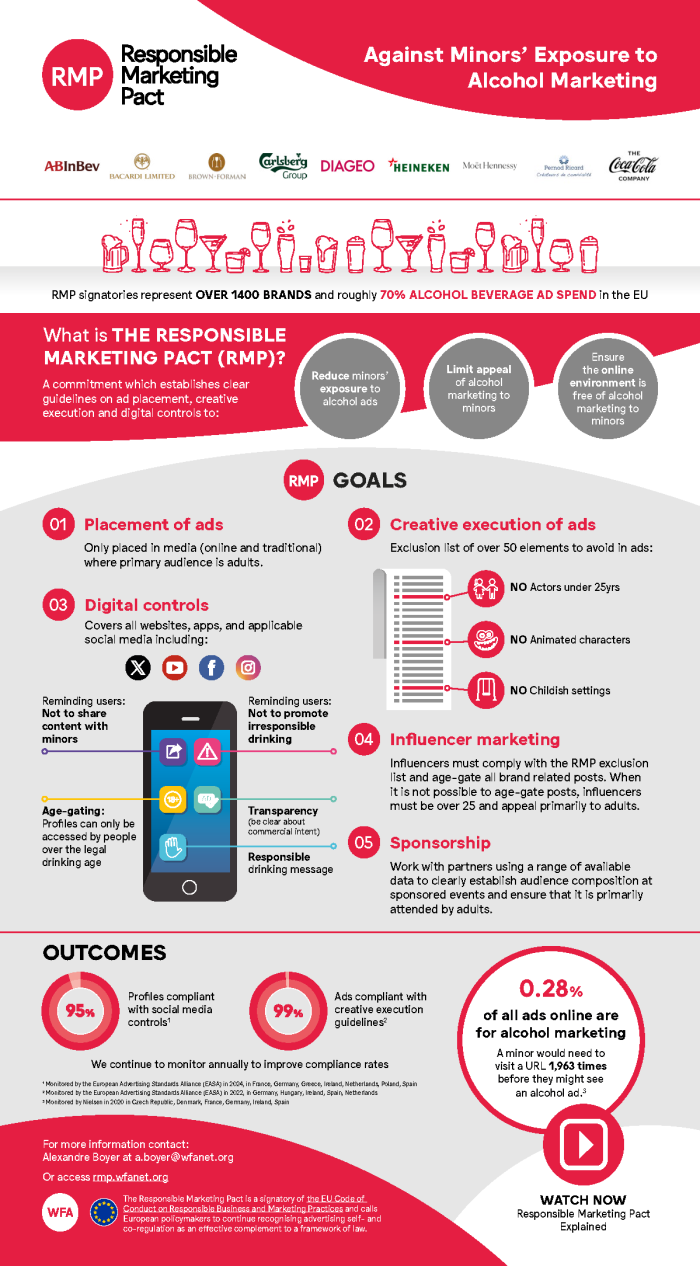
- Any actor/model below 25 years old in real life.
In addition, they must not feature:
- School teachers/personnel;
- Child/teenage-related leaders;
- Child-related performers & child-related entertainers;
- Child-related fairy tale characters.
Celebrities
Show more
Alcohol commercial communications must not feature:
- Any celebrity whose audience is primarily composed of minors;
- Any celebrity below 25 years old, whenever this celebrity actively and explicitly endorses the brand and is core to the commercial communication in his/her individual capacity.
Influencer Marketing
Show more
Online influencers must age-gate all brand related posts to prevent minors from seeing them. On platforms where it is not possible to age-gate posts effectively, influencers must be over 25 and appeal primarily to adult audiences.
Influencers will be made aware of the RMP exclusion list and will agree not to feature these elements in their brand communications.
Human Fictional Characters
Show more
Alcohol commercial communications must not feature:
- Any fictional character (or any associated elements) whose audience is primarily composed of minors;
- Any fictional character below 25 years old, whenever this character actively and explicitly endorses the brand and is core to the commercial communication in its individual capacity.
Animated/Cartoon Characters
Show more
Alcohol commercial communications must not feature:
- Any animated cartoon character extracted from a piece of work primarily viewed and/or read by minors;
- Any animated cartoon character whose style and design are evidently childish.
Dress Sense
Show more
Alcohol commercial communications must not feature any dress style and apparel evidently extracted from childish/teenage style, including:
- Any child/teenage-related uniforms;
- Outfits directly inspired by such uniforms.
Behaviour
Show more
Alcohol commercial communications must not feature any evident childish/teenage behaviour, including:
- Bullying;
- Teenage peer pressure;
- Teenage rebellion.
Gestures
Show more
Alcohol commercial communications must not feature any evident childish/teenage behaviour, including:
- Any gestures extracted from child/teenage body language.
Action (storyline)
Show more
Alcohol commercial communications must not feature:
- Any visual flashbacks to childhood and/or to adolescence;
- Childish pranks;
- Rites of passage from adolescence to adulthood;
- Teenage/childish challenges;
- Teenage romances/infatuations and ‘first times’.
Setting (place/time)
Show more
Alcohol commercial communications must not feature any childish/teenage-related settings, including:
- Any child-related fairy tales and/or child-related fantasy worlds;
- Schools;
- Child-related attractions, child-related roller coasters, and merry-go-rounds;
- Playgrounds;
- Zoos;
- Skate parks;
- Teen clubs;
- Indoor game arcades accessible to minors;
- Summer camps for minors.
Music
Show more
Alcohol commercial communications must not feature:
- Any music of a singer/musician whose audience is composed mainly of minors;
- Any music/song which is primarily listened to by minors;
- Any singer/musician younger than 25 years old when the song explicitly promotes a brand, the band is promoting the brand and the musician in question is core to the commercial communication in her or his individual capacity.
Sports
Show more
Alcohol commercial communications must not feature:
- Any athletes whose audience is primarily composed of minors;
- Any sports which are primarily followed by minors;
- Any athlete below 25 years old, whenever he/she actively and explicitly endorses the brand and is core to the commercial communication in its individual capacity.
Drawings
Show more
Alcohol commercial communications must not feature:
- Any child scribbles or drawings;
- Any drawings the style and design of which are evidently childish.
Objects
Show more
Alcohol commercial communications must not feature objects used primarily by children and teenagers including:
- Child-related toys;
- Objects extracted from child/baby tableware sets;
- Dummies;
- School-related objects.
Appeal
Show more
Alcohol communications for alcohol alternatives (ABV at or below 0.5% and style or brand commonly associated with alcohol) should not appeal to minors and respect the exclusion list.